

Storage Game Loading Test: PCIe 4.0 SSD vs. PCIe 3.0 vs. SATA vs. HDD
Today we're revisiting storage performance with an emphasis on gaming. Since we tested the first batch of PCIe iv.0 SSDs about a twelvemonth agone, we've been wanting to run more tests. Up until now, most games have been built with hard drives in mind, simply every bit we movement into a new generation of game consoles featuring super fast PCIe SSDs, the storage requirements for gaming may alter in the coming years. We'll exist able to look back on this tests to meet how things have changed.
Some of the questions nosotros plan to answer today include: what sort of storage device exercise yous need to play today's games? Specifically, what sort of bulldoze provides the best loading times, then y'all're non sitting around and waiting ages to go into gaming. Part of this answer is obvious, SSDs are faster than hard drives, then we want to dial down a fleck and see what sort of SSD is required. Do you need a PCIe drive? Practice you lot need something with a DRAM cache? Are certain retention technologies worse than others?
We'll be loading up a diverseness of games, and timing how long it takes to become into a playable level from the chief screen. Loading screens are the main thing impacted by storage functioning in games, everyone wants to get in and play games immediately, and so nosotros'll be testing that across a selection of different titles.

We accept included PCIe iv.0 drives in today's storage suite, so our testbed consists of a Ryzen 9 3900XT running on tiptop of MSI'southward X570 Tomahawk, 16GB of DDR4-3200 memory and a GeForce RTX 2080 Ti (considering Steve is hoarding all the RTX 30 GPUs) built inside a Corsair case. The storage setup sees the arrangement running off an M.ii drive in the second slot, with our games for testing running on a split drive in the primary K.2 slot, which has straight lanes to the CPU.
The Drives
Permit'southward work our way through the drives nosotros'll be testing because we have 14 different options on hand. Representing Team Hard Drive in today's boxing is the Western Digital WD120EMAZ 12TB. This is a standard OEM drive used for archival storage, with a 5400 RPM speed, 256MB cache and SATA 6 Gbps interface. We're fully expecting this guy to be slow.

Team SATA SSD has iii contenders. Our entry-level model is the Team Grouping GX1 500GB, which uses SanDisk TLC NAND, a Phison S11 controller and does not feature a DRAM enshroud. One step up is the Crucial MX500 2TB which packs Micron TLC NAND, an SMI SM2258 controller and a DRAM cache. And then for the big data hoarders we have the Samsung 870 QVO, with Samsung's QLC retention and controller, along with an 8GB DRAM cache.


We take lots of PCIe 3.0 x4 SSDs for today's testing besides.
From Western Digital nosotros have both the WD Black SN750 and WD Blueish SN550 in 1TB capacities. Both use SanDisk TLC, simply the SN750 has a DRAM cache where the SN550 does not. You'll also spot this pre-installed heatsink on the SN750.


Adata has provided their SX8200 Pro 1TB, which has an SMI controller and TLC NAND from Micron, with a DRAM cache. And then this is an alternative to the SN750 with different components. We too have the Sabrent Rocket 2TB, a popular option that uses the Phison E12 controller and Toshiba TLC NAND with a DRAM cache.
So rounding out our PCIe 3.0 offerings are 2 QLC drives. The kickoff is the Intel SSD 665p in a 1TB chapters, which uses an SMI SM2263 controller alongside Intel'south own QLC retentivity. Then as an alternative solution, nosotros besides have the Sabrent Rocket Q 2TB, which features a Phison E12S controller and Micron QLC NAND. Both drives as well feature DRAM caches.


And so we have 3 PCIe iv.0 drives, all of which use essentially the aforementioned design. The Seagate Firecuda 520 1TB and Corsair Force MP600 1TB both accept TLC NAND from Toshiba and Physon E16 controllers. The Sabrent Rocket four.0 2TB is similar, simply with a larger capacity.


And last but not least, we have an SSD with a USB interface, the Samsung T5. This drive features USB 3.ii Gen 2x1 and TLC retention from Samsung along with, as you might take guessed, a Samsung controller. In that location'southward too a DRAM cache here, as is the case for the PCIe 4.0 drives.

Synthetic Benchmarks
Before getting into the game data, let's run a single synthetic workload, CrystalDiskMark, to see what the numbers say. This is a typical workload you might burn down up on your new SSD after you get it to see those super high numbers, so how do these drives stack upwardly?
For sequential reads, it'southward a pretty uncomplicated story. At the summit with 5 GB/southward transfer speeds, are the PCIe 4.0 drives. All of the PCIe 4.0 drives are in the range of xxx to 40 percent faster than the next group of higher end PCIe iii.0 drives for performance.

One pace downward from that are the more entry-level PCIe 3.0 offerings, such as the SSD 665p and SN550. So we see the SATA drives, capped to effectually 550 MB/s sequential reads, and the hard drive comes in last. More often than not the deviation between a PCIe 3.0 drive and a SATA bulldoze is that the PCIe 3.0 model has up to 7x faster sequential reads.

For sequential writes, the story doesn't modify much either, although this is peak operation from writing into those DRAM caches.
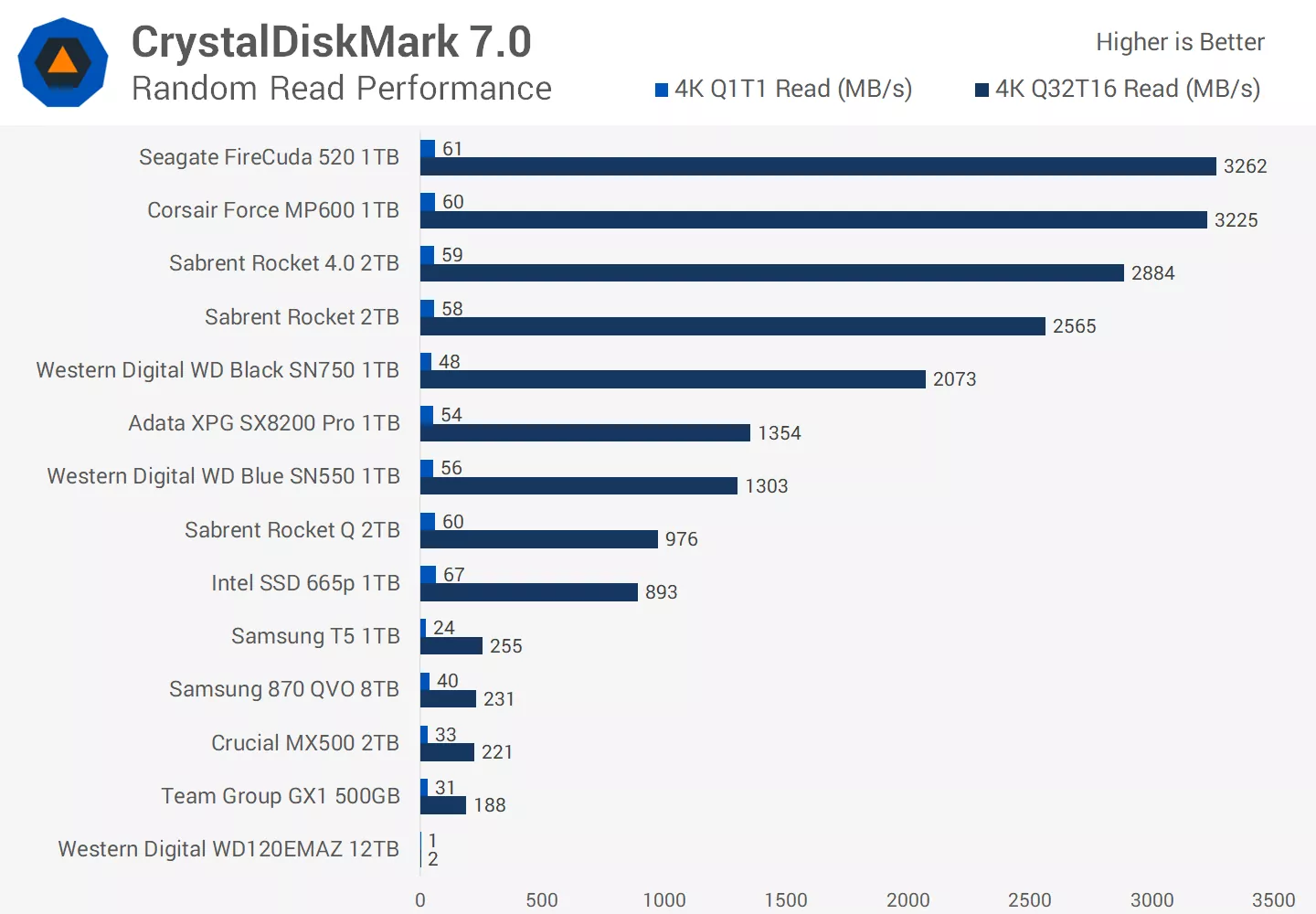
Things get more interesting when information technology comes to random operation, although at high queue depths at that place is still an reward going PCIe 4.0 over 3.0. The QLC-based PCIe 3.0 SSDs deliver the least impressive operation here, less than half that of the better TLC models. SATA SSDs too suffer, offer but a quarter of PCIe iii.0 performance in the best cases.
Of course, for single queue depth random reads, there isn't much separating a lot of these drives, except for the difficult drive which is very slow in comparison to even the slowest SSD.

Here'southward the random write performance too, while writing random data isn't as strenuous as reading information technology for some of these drives, SATA models do suffer once more with only 1/5th the performance on offering.
And so that's a quick look at the synthetic numbers. Based on this, it looks like PCIe iv.0 drives are clearly the fastest in this test, followed every bit expected by the higher-cease, then more entry-level PCIe iii.0 drives. These NVMe options are then much faster than SATA drives, often 4x faster or more than, with the tiresome mechanical hard drive rounding out the grouping with peculiarly bad random performance.
But does this matter for game loading? Let's detect out.
Gaming Benchmarks
We want to start with Horizon Zero Dawn, one of the nearly resources-intensive games you can play on PC today. However, for load times, it'south non hugely dependent on storage performance, at least when you get into the SSDs.
The slowest SATA drive, the Samsung 870 QVO, offered a 73% speedup to load times versus the difficult drive, so it'south clear that having an SSD is important. But beyond that, there's merely a 36% improvement moving from the slowest to fastest SSD tested.
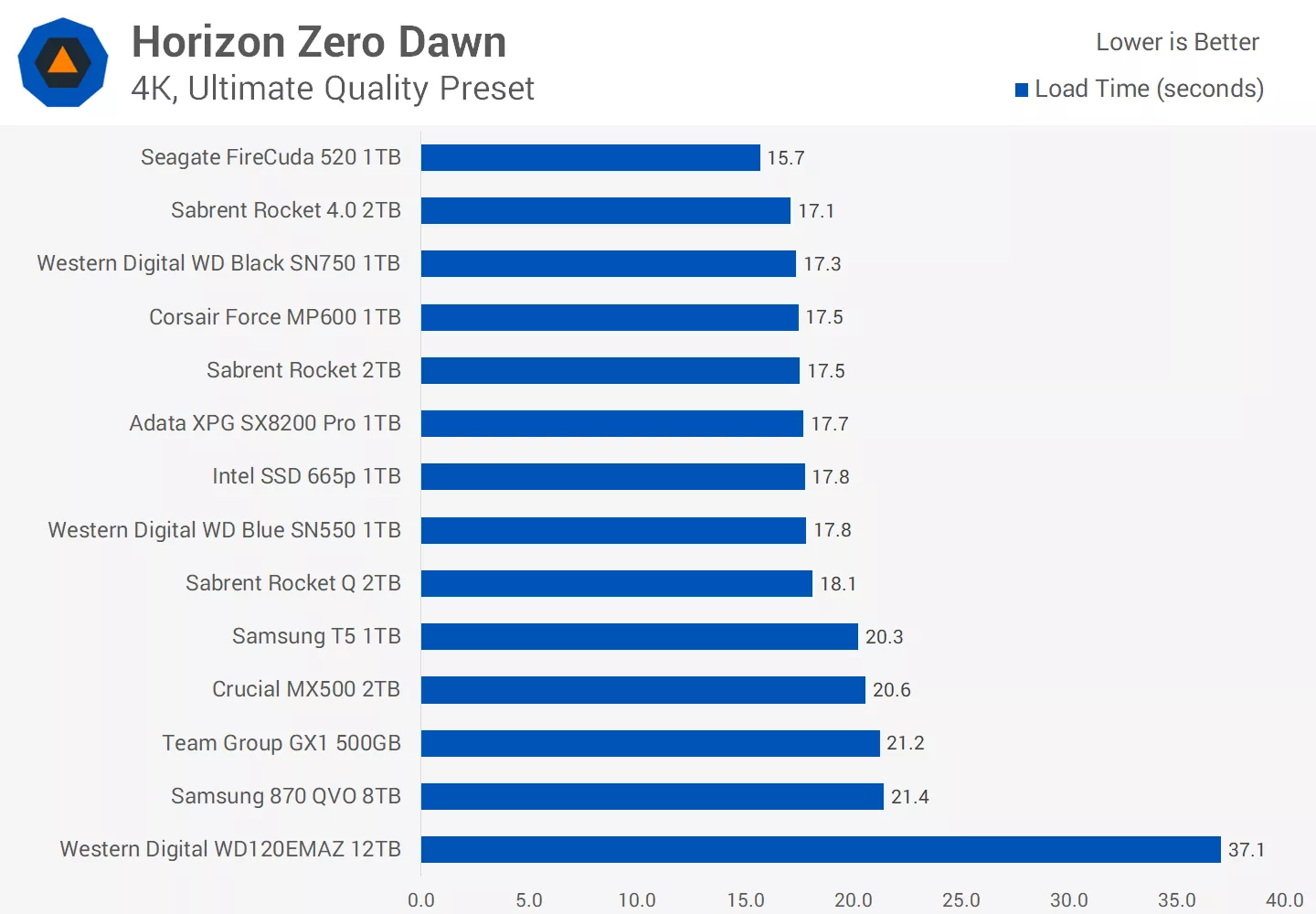
For loading Horizon Nada Dawn, there is no articulate advantage to having a PCIe 4.0 drive over PCIe 3.0. Despite the 4.0 drives putting up 30% amend read performance in CrystalDiskMark, when loading this game in the best case, the 4.0 drive was two seconds faster than the slowest 3.0 drive. At a 15% speedup, that'due south on the pocket-sized stop of the scale and that's comparing entry-level PCIe 3.0 in a drive like the SN550, to the peak-stop FireCuda 520.
There is a small gap between the SATA/USB and PCIe iii.0 drives. On boilerplate the non-PCIe SSDs loaded in 21 seconds, compared to 17 seconds for the PCIe equipped models. That'south a respectable 24% improvement, but it'due south not nearly in line with the huge differences in constructed workloads. We're talking drives that tin can pull 2GB/s reads easily, versus a cap of just 500 MB/s for the SATA models. That doesn't materialize when loading games.
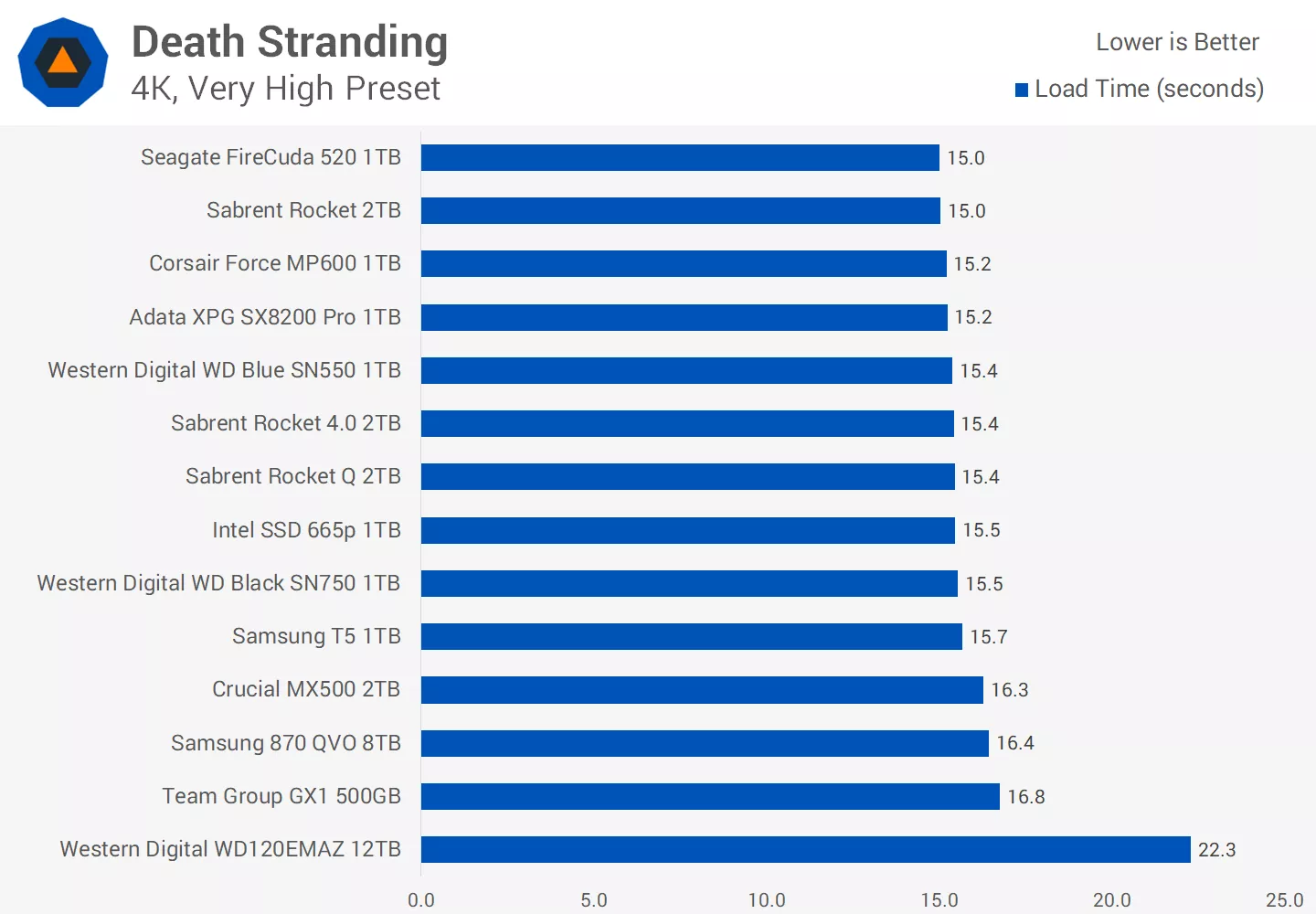
The difference is even less pronounced in Death Stranding. At that place was a mere 2 2d difference in load times between the fastest and slowest SSD models.
Yes, there is a tendency for the SATA drives to be slightly slower, but this is a marginal departure. Fifty-fifty the hard drive does reasonably well in this game, loading in 22 seconds.

In Shadow of the Tomb Raider nosotros see another 2-second departure between the fastest and slowest SSDs, so in this case upward to a xv% gain going from an entry-level SATA bulldoze to a blazing fast PCIe four.0 option. It'southward also articulate from the testing then far that having a DRAM cache, as expected, plays footling to no role in game loading: the DRAM-less SN550 is ane of the faster models for loading this game.
Yet, information technology's clearly amend to have at to the lowest degree some grade for SSD for loading Tomb Raider. Loading from a hard bulldoze was more than than twice as dull, and while overall load times aren't terrible on a difficult drive, a unproblematic speedup from an SSD is worthwhile.

Ruby-red Dead Redemption 2 is ane of the slower loading games in our examination suite, which is why we chose to use information technology. Nevertheless, these dull loading times exercise non appear to be every bit a result of storage bottlenecks, at least with an SSD. Well-nigh drives loaded this game in effectually 40 seconds, with a negligible difference between loading from a SATA or PCIe drive. However, it is worth having an SSD, every bit you'll shave 23 seconds off the load fourth dimension versus a difficult drive.

Borderlands 3 is an interesting case as we were looking at the loading time for both loading into the level, and waiting for the assets and textures to load in. When loading this game, oft you'll have to look a few seconds for everything to be fully rendered. Despite this, the game doesn't announced to be storage express during this procedure, as all SSDs took between 17 and nineteen seconds to load the game and its assets fully.
In fact, virtually all of these drives loaded into the level within about 11 seconds, and then there were some pocket-size differences in texture loading time. In any example, with some of the entry-level SATA drives performing well, and say the Sabrent Rocket 4.0 being not quite equally quick, information technology appears the engine is more to blame for loading than the storage y'all're loading from.
This is another game where we didn't see a big speedup coming from a hard drive to SSD. Yes, SSDs were noticeably faster, but not to the extent of a game like Horizon Null Dawn or Shadow of the Tomb Raider.

The Outer Worlds was a game nosotros chose to test because information technology has a lot of loading screens. Luckily, if y'all're playing from an SSD, loading shouldn't be that painful as it was ane of the quickest games to load that we tested. Even so, it only appears to require an SSD to be fast, not any specific sort of SSD. Once you have solid state storage at hand, there was but a 1 2nd divergence between the fastest and slowest models. And there was no preference for PCIe over SATA, it was a bit of everything.
One thing is articulate though: get an SSD for playing Outer Worlds, as they are more than twice every bit fast for game loading versus a hard bulldoze. Playing this game off a hard bulldoze would become pretty frustrating, constantly having to put up with 25 second load times when you could exist loading in at 11 seconds.

Assassin's Creed Odyssey, loading into the center of Athens, is some other title where your choice of SSD doesn't affair. PCIe drives were, on average, just 7% faster than non-PCIe drives for loading into the game, which is a negligible difference. In that location was no clear advantage to PCIe 4.0 drives at all, with the additional speed of those models providing no do good.

Next we have loading into The Division 2. In this game we're looking at loading with all textures rendered, with the time taken from after the game connects to the live service, to the concluding textures beingness loaded. This title behaves more than like Horizon Zilch Dawn in that there is a modest but more than noticeable reward to some SSDs over others, and having faster storage can speed upward your entry into the game world.
The differences aren't huge though. An entry-level PCIe iii.0 SSD like the SN550 is less than x% faster than a value champion like the Crucial MX500. And some of the faster PCIe drives load the game fully effectually 20% quicker than the more entry-level models. There is a half dozen second deviation between the best and worst SSDs, but we're still well off some of the results nosotros saw in our synthetic workload from earlier.
Still, there is a moderate improvement moving from a hard drive, so nosotros suspect most gamers will want to play this game on an SSD, like all the others we've been looking at.

The concluding game nosotros wanted to check out is Planet Coaster. The reason is that loading into simulation games with large worlds is known to be particularly slow across pretty much all of these sorts of games. So whether you're loading a big theme park, or a big urban center in a globe building game, you can expect load times that take multiple minutes.
Still what's actually of import to realize is these load times are not due to boring storage speeds. When loading a huge Planet Coaster park, generally the game took at least 6 minutes to load on my 3900XT organization, with a 26 second difference betwixt the fastest and slowest drives.
There's not much of a departure between a hard bulldoze and SSD for loading this game, and a barely noticeable tendency for faster PCIe drives to get an edge over SATA models. With a seven% deviation splitting the fastest and slowest drives -- when you're having to wait over half dozen minutes even with a super fast PCIe iv.0 SSD -- isn't really worth talking about.
The simple fact is that in these sorts of games, at that place is far more processing work that goes on when loading a level, than there is copying from storage into organization or GPU memory.
Making Sense of the Information

Afterward working through all of this data, nosotros don't think there are too many surprises in hither for PC gamers. Everyone should know at this indicate that if you want to improve game loading times, upgrading from a hard drive to an SSD is a no brainer. In all instances, the mechanical disk was the slowest storage device for loading, and in many cases upgrading to even the slowest SSD led to games loading in one-half the fourth dimension. Hard drives are fine for archival storage of games, but moving the game you're currently playing to faster storage makes a lot of sense.
What has go blatantly clear from this test is that it doesn't matter what sort of SSD you have for gaming, so long equally it's an SSD of some sort.
In six of the ix games we tested, there was only a 2 second deviation in load times between an entry-level SATA SSD and the absolute fastest PCIe 4.0 drive. In percentages, this was usually beneath a xv% performance uplift moving from the fastest to slowest drive, which is hardly worth talking about.

In the best cases, like Horizon Nothing Dawn and The Division ii, we saw upwardly to a 35% speedup for load times moving from entry-level SATA to super fast PCIe 4.0, but what we're talking about in absolute numbers is the deviation between waiting 21 seconds or xvi seconds.
There's as well little difference between different SSD specifications. PCIe 4.0 vs iii.0 provides essentially no benefit in most cases, especially compared to a top-cease PCIe 3.0 drive. QLC retentiveness is non slower than TLC for reading game files. Having a DRAM cache is also not important for game loading. The just specification that has some influence is whether the SSD is SATA or PCIe, with SATA being slightly slower, just beyond that, other specs are rather meaningless for gaming.
What We Learned
Why don't games benefit all that much from faster SSDs? Well, it seems articulate that raw storage operation is non the main bottleneck for loading today's games. Pretty much all games released up to this point are designed to be run off difficult drives, which are very boring; subsequently all, the previous generation of consoles with the PS4 and Xbox One both used slow mechanical drives to store games.
Today'southward game engines simply aren't built to make full use of fast storage, and so far in that location's been little incentive to optimize for PCIe SSDs. Instead, the main limitation seems to exist things like how quickly the CPU tin can decompress assets, and how quickly it can process a level earlier information technology'south set up for action, rather than how fast it tin read data off storage.
While choosing an SSD for gaming is easy based on this data, at that place are some extra elements to consider...
If you are planning to play games off a secondary SSD in your system, so separate from your boot drive, buying an SSD for this chore is straightforward. You're ameliorate off buying an affordable SSD drive with a high capacity. Information technology'due south preferable to have more storage space for games than information technology is to become a slight performance uplift from PCIe.

However, in today's marketplace at that place often isn't a huge price deviation between a cheap SATA drive and a inexpensive M.2 PCIe SSD. An entry-level drive like the SATA model from TeamGroup in a 1TB capacity is oftentimes merely $20-thirty cheaper than say, a WD Blue SN550. That makes the SATA model amend value for gamers, but not by much. Where that gap widens is in the high capacity range: 4TB SATA drives such as the Samsung 870 QVO are much cheaper than 4TB PCIe models like the Sabrent Rocket Q. At 4TB, the Samsung model goes for effectually $500 while the Sabrent Rocket Q is closer to $750. At this capacity, it may make more sense to stick with SATA.
The i caveat we'd make to this recommendation is that some drives are much slower to copy data to than others. QLC-based drives, like the Samsung 870 QVO or Intel SSD 665p, can be boring to write to one time you get beyond their DRAM or SLC caches, and you're writing directly to the QLC retention. If you're going to copying files or games in and out of storage a lot, from another fast source, you lot may want to avoid a QLC bulldoze and stick with a TLC option. This volition exist more than expensive though, and QLC is still a bang-up choice for an archival-type SSD that you lot play games off.
If yous're going to accept but one bulldoze in your system that doubles as both a boot drive and a gaming drive , we'd make a somewhat different set of recommendations. Because in this situation, information technology'due south not just game loading that y'all're worrying virtually, just general organization tasks besides like other app loading. While we purposely didn't cover annihilation other than gaming in this article, we've covered full general storage performance tests before and we still think it'south important to talk almost information technology briefly hither.
Every bit a boot drive, it is worth paying a premium for PCIe 3.0 storage, particularly given current pricing for i-2TB drives where PCIe doesn't cost that much more. We'd exist after something with a DRAM cache, so y'all go that nice pinnacle write performance, and preferably TLC retentiveness to avoid some of the functioning shortfalls of QLC.
For a gaming-focused build, we wouldn't go out of the way to get annihilation higher end and certainly wouldn't pay attention to whatsoever of the professional-focused drives with high-terminate controllers, like say the Samsung Pro line.

Pricing will vary depending on the retailer you're looking at, but something similar the SX8200 Pro or WD SN750 might be right around the mark of good value hither, with either bulldoze available around $130 for 1TB. The Sabrent Rocket is a popular choice besides. These drives are around $25 more than at 1TB than their DRAM-less or QLC based entry-level competitors. Equally a kicking drive, it's well worth spending that extra greenbacks.
We should notation, when we tested Sabrent's Rocket and Corsair's MP600 PCIe iv.0 drives at launch last year, the commencement matter that we loved almost them is that pricing was at par or below what used to be until then top-of-the-line NVMe PCIe iii.0 drives.
But – you might exist shouting or typing angrily into the comments – what about this next-generation of gaming? Don't the PS5 and Xbox Serial X pack powerful SSDs which will make SSD performance key for gaming? That's definitely a possibility, only we're likely talking about years down the track. API's similar Microsoft DirectStorage, which is designed to mimic the storage capabilities of these new consoles, has only simply been released for developers. Like with all technology transitions we've seen, one prior case being DirectX 12, it'll exist several years earlier we start to see these things harnessed in cross-platform titles on PC.
Shopping Shortcuts:
- Sabrent Rocket PCIe 4.0 SSD on Amazon
- Corsair MP600 PCIe 4.0 SSD on Amazon
- Samsung 870 QVO on Amazon
- WD Black SN750 on Amazon
- WD Blue SN550 on Amazon
- Sabrent Rocket Q on Amazon
- Sabrent Rocket on Amazon
- Seagate FireCuda 520 on Amazon
- Adata XPG SX8200 Pro on Amazon
- Intel SSD 665p on Amazon
- Crucial MX500 on Amazon
- Samsung T5 on Amazon
- Samsung 970 Evo Plus on Amazon

Source: https://www.techspot.com/review/2116-storage-speed-game-loading/
Posted by: swearingeneneas1946.blogspot.com
0 Response to "Storage Game Loading Test: PCIe 4.0 SSD vs. PCIe 3.0 vs. SATA vs. HDD"
Post a Comment